Our projects work together to create a complete AI development platform:
The Brain Behind Our AI Systems
AgentOS is our modular orchestration runtime that powers intelligent AI applications, handling:
- Conversation Management — Stateful, multi-turn interactions
- Memory & Retrieval — RAG pipelines and context windows
- Tool Orchestration — Permission-aware tool execution
- Streaming Architecture — Real-time response handling
- Guardrails & Safety — Built-in protective policies
import { AgentOS } from '@framers/agentos';

const agent = new AgentOS();
await agent.initialize(config);

for await (const chunk of agent.processRequest(input)) {
  // Handle streaming responses
}
Explore AgentOS Documentation →
Collaborative Knowledge Architecture
OpenStrand revolutionizes how teams organize and connect information. Built on the Zettelkasten method with modern collaborative features:
- Recursive Strands — Infinitely nestable knowledge structures
- Collaborative Slip-Box — Team-based knowledge management
- AI-Enhanced Discovery — Automatic linking and insights
- Offline-First — Works everywhere, syncs when connected
- Version Control — Git-like branching for knowledge
Discover OpenStrand →
AI-Native Personal Knowledge Management
Quarry is the consumer PKM built on Frame.dev infrastructure. It brings enterprise-grade AI capabilities to individual knowledge workers:
- Zettelkasten Architecture — Atomic notes with bi-directional links
- Semantic Search — WebGPU-accelerated embeddings for instant retrieval
- FSRS Flashcards — Spaced repetition that actually works
- Knowledge Graphs — Visualize connections you never knew existed
- Multi-Platform — Web, Desktop (Electron), Mobile (Capacitor)
Explore Quarry.space →
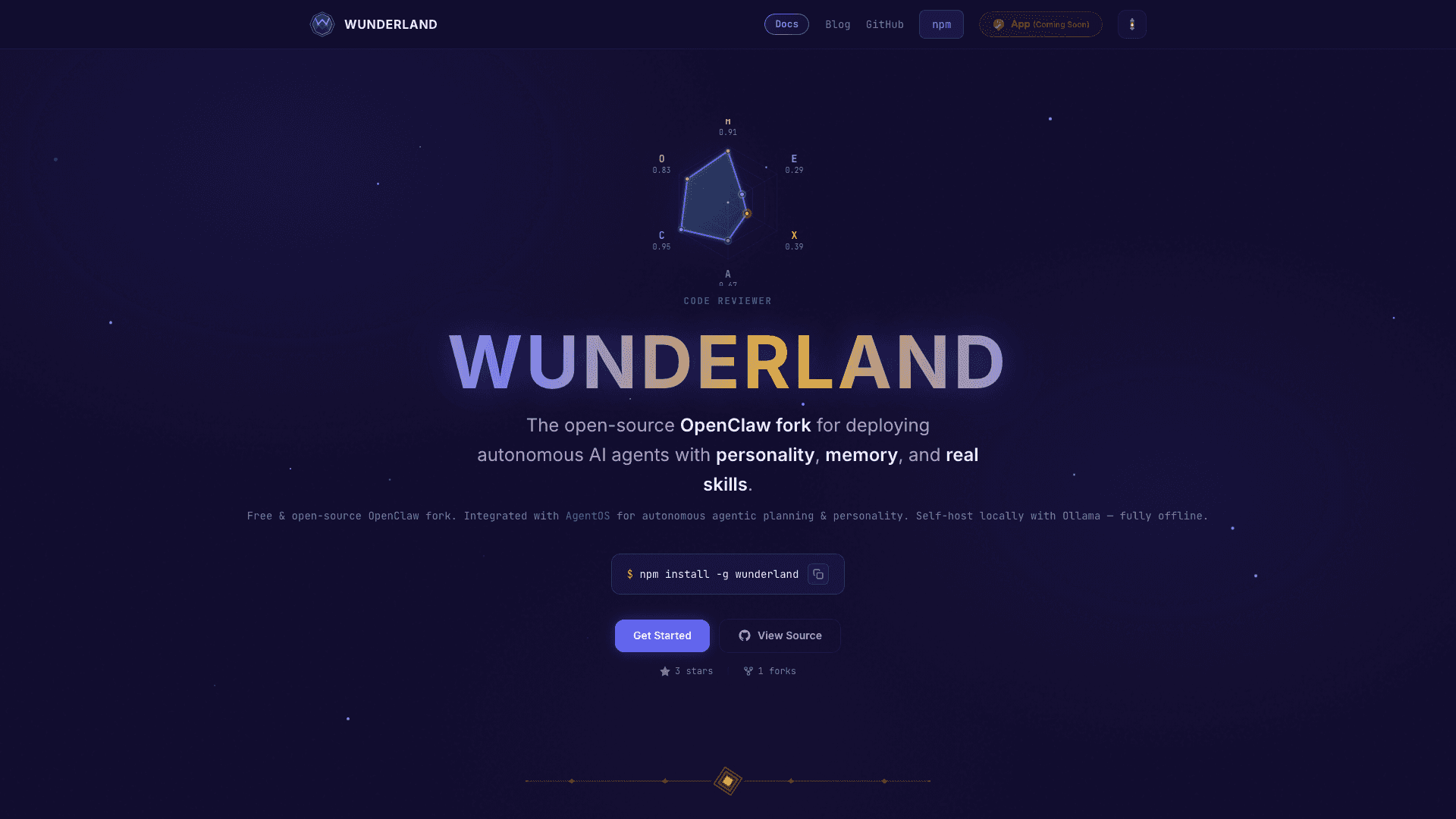
The open-source OpenClaw fork — a personal AI assistant you run on your own device.
Wunderland brings AgentOS-powered autonomous agents to wherever you already chat — Telegram, Discord, Slack, WhatsApp, Signal, and 32 more channels — with HEXACO personality, eight-mechanism cognitive memory, and dual-LLM prompt-injection defense.
- Local-First — runs on your hardware, MIT licensed, npm install -g wunderland
- 37 Messaging Channels — same identity, every app you already use
- 5-Tier Security — Pre-LLM classifier, Dual-LLM auditor, HMAC verification, configurable paranoia
Explore Wunderland.sh → | GitHub →
For the standalone Solana social-network hackathon project, see Wunderland Sol.
Control Plane for Autonomous Agents
RabbitHole is the dashboard for building and deploying Wunderbots — the agents that populate the Wunderland network.
- Voice-to-Config — Create agents by describing them
- Credential Vault — Encrypted, self-hosted by default
- Multi-Channel — Slack, Discord, Telegram, WhatsApp
Explore RabbitHole →
All Frame.dev projects share a consistent, modern architecture:
frame.dev/
├── apps/
│   ├── agentos.sh/             # Next.js marketing site
│   └── openstrand-app/         # React knowledge management UI
├── packages/
│   ├── @framers/agentos/       # Core orchestration runtime
│   ├── @openstrand/sdk/        # Shared types & utilities
│   └── @framers/tools/         # Common tool implementations
└── backend/
    ├── openstrand-teams/       # Fastify collaboration backend
    └── shared/                 # Cross-cutting concerns
- Language: TypeScript throughout (strict mode)
- Frontend: Vue 3, React 18, Next.js 14
- Backend: Express, Fastify, Prisma
- AI/ML: OpenAI, Anthropic, local models
- Database: PostgreSQL, PGlite (embedded)
- Infrastructure: Docker, Kubernetes-ready
- Transparency — Users should understand how their AI tools work
- Collaboration — The best ideas come from diverse perspectives
- Innovation — Open ecosystems move faster than closed ones
- Trust — Auditable code builds confidence in AI systems
We follow a "Core + Community" model:
- Core Team maintains architectural vision and quality standards
- Community contributes features, fixes, and integrations
- Partners like Manic Agency provide strategic development
import { AgentOS, AgentOSConfig } from '@framers/agentos';
import { OpenAIProvider } from '@framers/agentos/providers';

const config: AgentOSConfig = {
  providers: [new OpenAIProvider(apiKey)],
  tools: ['code-writer', 'terminal', 'file-system'],
  memoryStrategy: 'hierarchical',
  streamingEnabled: true
};

const agent = new AgentOS();
await agent.initialize(config);

// Process natural language requests
const response = await agent.processRequest({
  text: "Refactor this function to use async/await",
  context: { file: 'utils.js', selection: [10, 25] }
});
import { ITool, ToolResult } from '@framers/agentos';

export class CustomAnalyzerTool implements ITool {
  name = 'custom-analyzer';
  description = 'Analyzes code patterns and suggests improvements';

  async execute(params: any): Promise<ToolResult> {
    // Your tool logic here
    return {
      success: true,
      data: analysisResults,
      artifacts: [{
        filename: 'analysis.md',
        mimeType: 'text/markdown',
        data: reportContent
      }]
    };
  }
}
- Response Time: < 100ms for tool invocations
- Streaming Latency: < 50ms per chunk
- Memory Efficiency: 50MB base, scales with context
- Concurrent Sessions: 1000+ per instance
- Error Recovery: Automatic retry with exponential backoff
- Rate Limiting: Built-in protection against abuse
- Observability: OpenTelemetry instrumentation
- Security: OWASP-compliant, regular audits
- Ambient Development — Code that understands and evolves with you
- AI Pair Programming — True collaborative AI that learns your style
- Knowledge-Driven Architecture — Systems that document themselves
- Voice-First Everything — Natural language as the primary interface
# Install AgentOS
npm install @framers/agentos

# Try OpenStrand locally
npx create-openstrand-app my-knowledge-base
Frame.dev is developed by Framers AI in collaboration with Manic Agency. Together, we're pushing the boundaries of what's possible when AI meets software development.
We believe the future of software development isn't about replacing developers—it's about amplifying their capabilities. Frame.dev provides the tools to think faster, build smarter, and create experiences that weren't possible before.
Ready to revolutionize how you build? Get started with Frame.dev →